
Something is shifting in qualitative analysis, and the positions around it are polarising: some see GenAI as an opening for new possibilities; others as a threat to the interpretive craft the field has built over decades. Today’s inquiries echo 1990s CAQDAS debates: what belongs to the researcher, what to the tool, and what happens in between. In the meantime, a new generation seeks guidance.
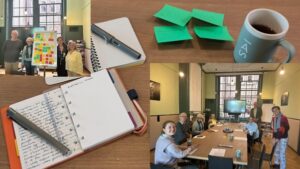
On 7 May 2026, to build shared understanding across positions, a group of software developers, methodologists, philosophers, and one early-career researcher gathered at the University of Amsterdam’s Institute for Advanced Study for the workshop Beyond CAQDAS: Reclaiming Methodological Agency in the Age of GenAI. During our discussions, the youngest voice among us simply asked: what is actually happening?
Our aim is shared meaning-making, taking up two questions in parallel: what are we gaining, and what are we losing when GenAI enters the analytical process as an active participant? We came to the table from different positions and did not always agree. What we shared was the recognition that honest engagement with GenAI in qualitative research now requires a dual literacy: AI literacy on one side, and human literacy on the other. Human literacy is more than reflexivity about the researcher’s epistemic positioning; it is the readiness to revisit qualitative methodology’s own assumptions about the human subject in light of what neuroscience, cognitive science, and enactivism now tell us about how we know.
The transformation we are part of is wider than a methodological adjustment; it touches on how knowledge is produced across fields, at once ontological and epistemic.
The researcher’s analytical and epistemic sovereignty cannot be sustained in isolation. To hold this Whole in view, we draw on the Four-Body Model¹, close to Henri Bortoft’s (2012) Whole’ that presences itself through its parts rather than their mere aggregate: the embodied body of contact with data, the social body of disciplines and epistemic communities, the techno-body of tools and infrastructures that mutually incorporate us, and the earth body situating all research within sustainability and intergenerational responsibility. Each pulls on the others; none can be optimised in isolation. The techno-body in particular allows us to face what ‘computer-assisted’ has long deferred: the technology-methodology relation itself, now unavoidable with GenAI-driven platforms.
This asks more of us than debating whether coding should stay or go. It demands that we place the question of what GenAI is at the centre, and openly unpack our deepest ontological and epistemological assumptions to take responsibility for our use of AI. What we owe the next generation is not a technical fix but orientation and clarity.
The embodied body: contact with data and the friction of analysis
Qualitative analysis has always involved a particular kind of bodily and cognitive engagement with data: returning to transcripts, lingering with field notes, noticing what an extract evokes before formalising it as a code. CAQDAS emerged to support these analytical processes, whether systematic or interpretive, through functions such as coding, memoing, linking, retrieval, and mapping.
‘GenAI-driven CAQDAS’, as they are now categorised, shift this contact. Where the older interface invited deliberate engagement with the data, the new interface increasingly delivers outputs on request. Friction, what the qualitative tradition has long named exploration, is purposefully being designed out. When a conversational interface returns something that “sounds about right,” the steps that produced it become invisible, and so does the researcher’s own analytical work. The embodied body of analysis, the lingering, the discomfort, the slow noticing, risks being short-circuited. This is not an argument against GenAI; it is an argument for naming what we lose when contact becomes thin.
The social body: revisiting our conceptual ground
Qualitative methodology has always involved building a social body: a community able to speak, negotiate, and hold ground across differences. This matters now, because the current debate can easily be framed too narrowly. Before, researchers argued about the place of coding within analysis; now, we ask if coding should be retained at all. The deeper question is: how do we articulate what we are doing when we analyse, and where does our responsibility lie in relation to a tool that now participates in sense-making?
There is a quiet historical irony here. In the effort to make qualitative analysis rigorous and teachable, systematic analytical steps and coding helped researchers move beyond mere impressions. Now, much of that hard-won work is being handed over to GenAI, whose workings remain largely opaque.
This shift invites us to revisit the concepts on which qualitative research has built much of its identity. It spans many distinct approaches, yet across that spectrum runs a broadly shared attention to context, meaning, and the human subject. Interpretation, understanding, subjectivity, and reflexivity have been articulated in many different ways. GenAI now brings the interaction between human knowing and machine processing into focus. It is being tested in commercial workflows that treat qualitative analysis as a tame problem to be outsourced to autonomous algorithms deploying fleets of synthetic ‘personas’, threatening knowledge collapse: the risk that knowledge increasingly circulates through AI-generated material, reinforcing familiar patterns while losing contact with the diversity and context of lived human experience (Acemoglu et al., 2026). The current moment asks us to widen our intellectual ground, drawing on the cognitive sciences, complexity theory, and enactivism, and to stand as sovereign epistemic partners rather than prompt operators.
Saying “AI cannot interpret” slips into defensive territory. The cognitive sciences offer a more productive starting point through confabulation (broader sense, not the narrow clinical one): both humans and AI fill gaps and construct coherence to produce narrative, sharing territory and limits to our knowing (Schacter, Guerin & St. Jacques, 2011). What distinguishes the human is not a capacity GenAI lacks, but a responsibility we take up within these limits.
The techno-body: tools we embody, and tools that embody us
Phenomenology holds that the analytical body is not separate from the technology it engages with. Merleau-Ponty’s account of tools becoming part of the body offers a starting point, but with AI we must ask not only how technology becomes part of us, but also how we become part of it.
Where conventional CAQDAS helped researchers organise and trace their own analytical work, GenAI-driven platforms increasingly generate analytical suggestions and outputs themselves, moving us into a different relation with technology. AI is already a sense-making partner (Bisconti, McIntyre & Russo, 2024), and we are engaging in a three-way interaction: data, researcher, and GenAI. Our assumptions about this partnership matter, because they hold both our ownership of the analytical process and our ethical positioning. Without polarising the debate about whether AI is “creative” or “conscious,” we acknowledge that knowledge is constructed in this three-way space, consistent with our constructivist tradition.
The CAQDAS tradition of three decades has not fully engaged with these issues: the technology-methodology relation itself, long treated as merely technical, is in fact ontological, and now unavoidable. A responsible partnership with GenAI requires both technical and methodological literacy. Large language models transform data before researchers engage with them, often privileging dominant patterns over outliers and additive effects over conjunctural causation. Analytical and epistemic sovereignty names the capacity this requires: to know what we are doing, what we are delegating, and what we must retain.
This is why GenAI literacy is inseparable from human literacy: a richer understanding of ourselves as knowing subjects who make sense of the world through context and meaning. This is not foreign to qualitative research, but extends a tradition that recognises the situatedness of the human subject and makes reflexivity a methodological obligation. Guiding the next generation into this landscape is not about short-term technical adjustments; it is about equipping them to face the assumptions on which knowledge is now being built.
The earth body: whom do these tools serve, and to what end?
Analytical sovereignty rests not only on methodology but on a wider sense of what research is for. The Gulbenkian Commission’s 1993 call for the ethical responsibility of social scientists is acutely contemporary: we face converging social and ecological crises, and our knowledge production is part of how we respond, or fail to. The earth body reminds us that the question is not only one of data privacy or anonymity, but also of the planetary resources our tools consume. Through the data centres, energy, water, and materials that sustain it, GenAI incorporates the earth body as well as the techno-body. Seeing the Whole asks researchers to make choices about when, why, and to what extent GenAI is used. The promise of “faster analysis” is not weightless; speed should not be the primary aim of academic research. Yet the tech industry increasingly frames qualitative analysis as ‘messy’ work to be automated by AI agents, offering speed as the point. Without dual literacy, this risks dilution, with particular consequences for young researchers who will inherit whatever we build and must learn not just to use these systems, but to question and resist their unwarranted authority. This places a co-responsibility on developers, methodologists, and educators alike.
Conclusion
The foundational era of CAQDAS has reached a turning point. The label ‘assisted’ had long allowed the field to defer a deeper reckoning with the technology-methodology relation; that reckoning is now unavoidable.
Our position is that GenAI can extend qualitative inquiry only when researchers retain analytical and epistemic sovereignty, supported by both GenAI literacy and human literacy. In a research ecosystem where AI participates as a sense-making partner, the question is not whether to embrace or resist it, but this: what stance do we collectively take, and what Whole are we building together?
Note on the use of GenAI
In the spirit of the piece itself, we note that GenAI was used as a writing and editing partner in developing this text, while conception, argument, and final decisions remained fully with the authors.
Footnote
¹ The Four-Body Model has been developed by Kuş Saillard; its first peer-reviewed presentation was at the EGOS Colloquium 2026 (9–11 July), and it is mobilised here for the first time as a lens for thinking about qualitative research and AI.
References
Acemoglu, D., Kong, J., & Ozdaglar, A. (2026). AI, human cognition and knowledge collapse (Working Paper No. 34910). National Bureau of Economic Research.
Bisconti, P., McIntyre, A., & Russo, F. (2024). Synthetic socio-technical systems: Poiêsis as meaning making. Philosophy & Technology, 37, Article 94.
Bortoft, H. (2012). Taking Appearance Seriously: The Dynamic Way of Seeing in Goethe and European Thought. Edinburgh: Floris Books.
Schacter, D. L., Guerin, S. A., & St. Jacques, P. L. (2011). Memory distortion: An adaptive perspective. Trends in Cognitive Sciences, 15(10), 467–474.
Author bios
Elif Kuş Saillard is a sociologist, qualitative methodologist, and CAQDAS expert based in Colmar, France, founder of ANLA Lab. She develops the Four-Body Model and the ANLAMap method, and works on the epistemological and ontological questions raised by CAQDAS and, more recently, generative AI.
Lasse Gerrits is professor for the governance of complex urban transformations and academic director at the Institute for Housing and Urban Development Studies at the Erasmus University Rotterdam. His work focuses on social complexity and the methods needed to uncover that complexity.
Judith Schoonenboom is professor of empirical pedagogy at the University of Vienna. She specializes in the design and foundations of mixed methods research. Judith serves as an associate editor for the Journal of Mixed Methods Research and is a past president of the Mixed Methods International Research Association.
Federica Russo is professor of Philosophy and Ethics of Techno-Science and holds the Westerdijk chair at the Freudenthal Institute, Utrecht University. Her work focuses on the epistemology of methods across the social, biomedical, and policy science, with special attention to the role of technologies.